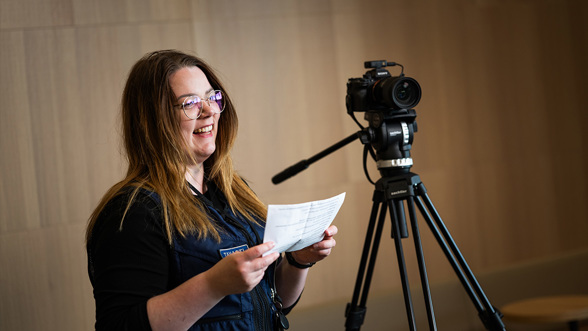
Four years ago, Paula Tavasti, 34, sat at home on the edge of her bed and tried to put on her socks despite severe back pain.
"Will I be able to continue working at the factory for the rest of my life?" she wondered.
Her work in the factory’s packing room was physically demanding with little variation. When the packaging machine broke down and the spare parts needed for repairing it were delayed, the work became even heavier. Packing large parcels by hand was simply too much for Tavasti’s back.
The next few weeks Tavasti persisted at work, but the pains did not ease. They always came back.
She booked an appointment with the occupational health physician, who took her problems seriously right away. She was referred to Oulu University Hospital for further examinations, and she hoped that her back could possibly be operated on.
"However, the doctor thought that surgery would not be worthwhile, as the problem could easily come back afterwards."
For a while, Tavasti felt like there was nothing to do.
Physician gives green light for vocational rehabilitation
Usually returned to the occupational health physician. Together, they established that there would simply be no duties at the factory and in her own field that she was able to do.
Tavasti asked the occupational health physician about her options. Her friend was studying a new profession as vocational rehabilitation. She wanted to know if that would be possible for her as well.
"I was very pleased that the doctor said that I could also apply for vocational rehabilitation."
Tavasti decided to seize the opportunity. She requested the necessary written statement from the occupational health physician and filled in the application online.
"Many people around me were afraid that it would be difficult to receive a positive decision. I decided not to care about what others were saying. Completing the application was easy."
Under a month later, she received a letter from Varma: she had received a positive decision. The journey towards a new career had begun.
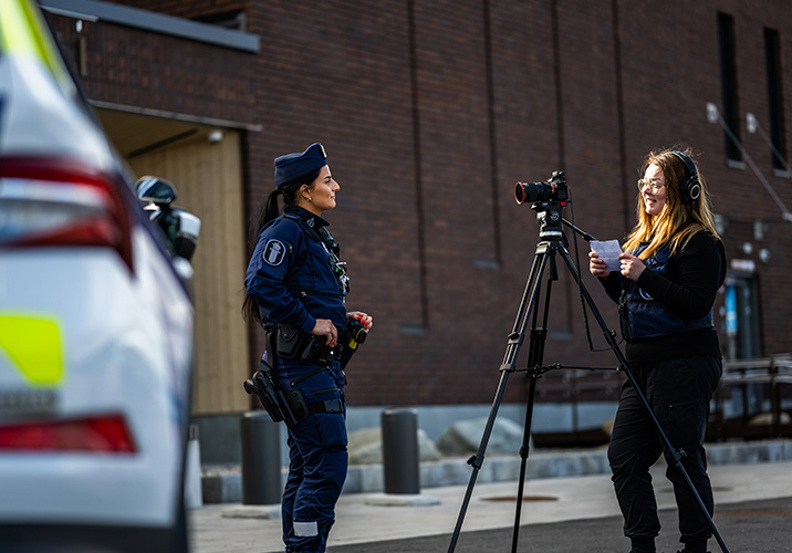
"I am a happy and talkative person. It has been useful when I’ve been looking for people in front of the camera," says Paula Tavasti, Communications Secretary at the Oulu Police Department. She is interviewing and photographing Detective Sergeant Ruusa Tiainen in front of the new Ruskonselkä main police station.
The communications sector was found with a job coach
After the positive decision, Varma offered a job coach from a rehabilitation partner company to assist Tavasti. She chose Innomari - Spring House Oy as her partner.
"The first time we met, I clicked well with the job coach. I felt that we both are people who get likewise enthusiastic about many things. I also sensed that the coach really wanted to help me."
Tavasti and the job coach began to think about alternatives for a new field together. Tavasti had previously completed a vocational qualification in mechanical and metal engineering. However, it was clear that there was no lighter physical work with more varied working positions, which Tavasti needed, in the mechanical and metal engineering industry.
Tavasti told her job coach about her interests. She had been an amateur photographer for years. The Association of Finnish Camera Clubs had also chosen her once as Young Photographer of the Year and twice as Photographer of the Year.
"My job coach suggested the communications sector to me so that I could use my photography skills. It immediately felt like a good idea. Varma confirmed that the training path can be supported as vocational rehabilitation, as the previous competence could not be utilised."
Therefore, Tavasti decided to apply to the Central Ostrobothnia University of Applied Sciences for a vocational qualification in media and visual expression. It was possible to complete the basic studies as multiform studies.
When she was informed of having been accepted, Tavasti was joyful. She was one step closer to a new job.
Apprenticeship led to fixed-term employment
Right from the start, Tavasti found studies in the media sector to be inspiring. Tavasti started the vocational qualification training of about two years as multiform studies, which meant studying mainly online. Since the training offered the option of completing the studies as an apprentice at a workplace, Tavasti decided to start doing something about it after six months of studies.
Tavasti stopped to think about what kind of place would best support her learning and a new direction in working life. She had been interested in police work for a long time and was wondering whether it could be linked to the media sector in some way. She decided to ask whether apprenticeship training could be possible at the Oulu Police Department.
"I boldly asked for an apprenticeship. As a sum of many coincidences, I was able to complete the rest of the training in the communications unit of the Oulu police.
During the apprenticeship, Tavasti worked and learned at the workplace and showed what she learned as demonstrations of competence.
Working in police communications turned out to be even more fascinating than Tavasti had imagined. Her task was to come up with ideas and produce content suitable for the police on social media, such as videos and photos.
"I am a happy and talkative person. It’s been useful when I’ve been looking for people to pose for the camera."
The value of Tavasti's work was also quickly noticed by the police. After graduating, she was offered a one-year fixed-term position as Communications Secretary at the Oulu Police Department. She gladly accepted the offer.
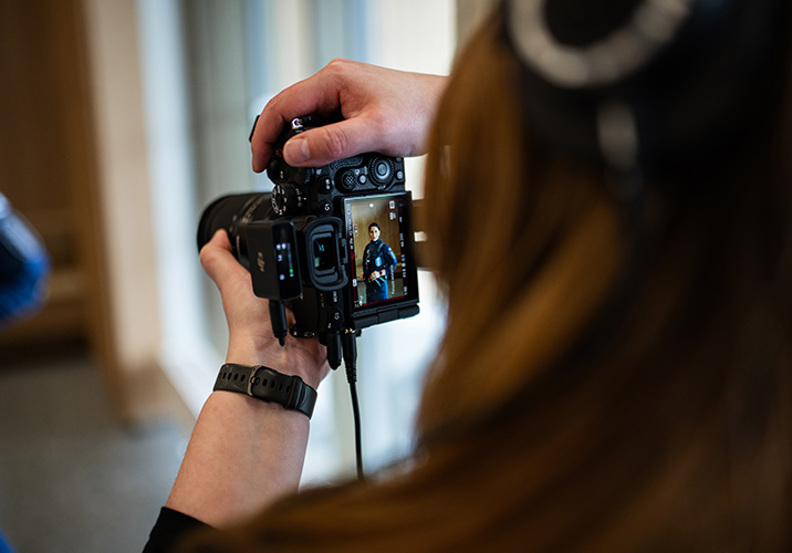
Paula Tavasti has been an amateur photographer for many years and has won several awards. In her current job, she creates ideas and content for social media.
The police want to reach a lot of people with their messages
The Oulu Police Department had not employed external rehabilitant career changers or communications students. According to Tavasti’s supervisor, Communications Manager Tero Väyrynen, internships are always considered as needed.
"Paula had exactly the skills we needed. She is a top-class photographer and knows how to create material that is suitable for the public image of the police organisation for social media."
A large number of followers is beneficial to the police, as it gives visibility to important matters. In social media channels, the police can, for example, report on dangerous situations or request observations or help with identification in connection with crimes.
"We use the material created by Paula to tell people about our work and connect with people," Väyrynen says.
Paula Tavasti feels that she is in her dream job. Every day has been so different that she has never felt bored.
"I’m really grateful that I got to study a new profession with Varma’s help.
Studies as vocational rehabilitation
Studies can be completed as vocational rehabilitation in many different ways.
Study forms include:
- Face-to-face training
Teaching takes place physically at an educational institution. Enables direct interaction between the teacher and students. - Remote learning/online studies
Learning takes place digitally, for example through online lectures and assignments. Offers flexibility regardless of time and place. - Independent study
Students study with the help of online materials or literature. - Multiform studies
A combination of face-to-face teaching, remote learning and independent study. - Apprenticeship training
Studies take place mainly at the workplace in practical work tasks. The student is employed and receives salary. The training includes theoretical teaching at an educational institution. - Training contract
Studies take place mainly at the workplace in practical work tasks. The student is not employed and does not receive salary. The employer provides the learning environment and the educational institution is responsible for the agreements.
The actual methods of studying can be theoretical, such as exams or learning assignments, or practical, such as demonstrations of practical competence in working life. The studies can be structured as a combination of different study forms and methods.
Many training options include internships at a workplace in the sector, regardless of the form of study.