
What is work ability management?

Work ability management means supporting employees’ resilience, health and well-being at the workplace. The objective is to ensure that employees are well and that they retain their ability to work. When work ability is managed strategically, more impactful results are achieved at both the individual and organisational level.

Why should work ability be managed strategically?

Strategic work ability management means making good work ability a strategic goal of the organisation. It is systematic actions that integrate work ability management into the organisation’s management system and day-to-day supervisory work. 

When the resilience and well-being of employees are carefully planned and managed as part of the entire workplace’s activities, it benefits both the employees and the workplace. Employees enjoy greater well-being, and the workplace is more efficient. Impactful work ability management is not just random actions – it is based on clear structures and operating models that everyone is familiar with and uses.

Elements of strategic work ability management

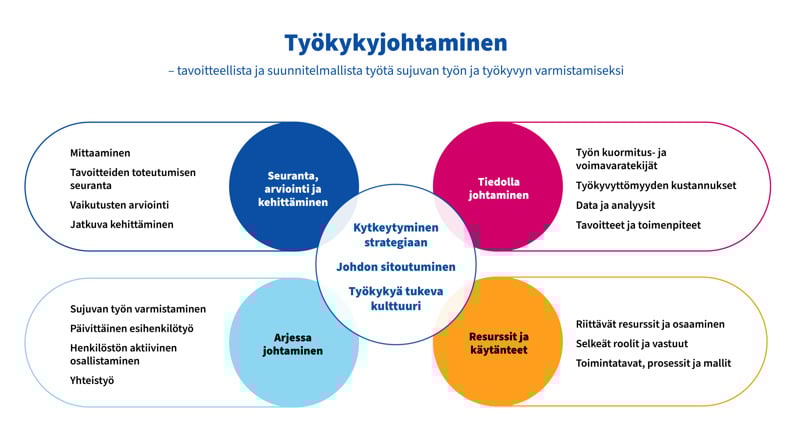
The starting point for strategic work ability management is a culture that supports work ability and which actively involves the employees in developing work ability management. When the employees participate in planning and assessing, the work ability culture is strengthened.

It is thus not just about single measures but about daily activities that are linked to the company’s strategy and goals.

Management is in a key position in creating this culture. It must be committed to ensuring work ability and understand how work ability affects the success of the entire organisation. 
Day-to-day management

Supervisors are in a key position when it comes to creating a culture where the work goes smoothly and work ability is taken into account as part of day-to-day routines. At the core is daily discussions, and not just taking action when there are work ability challenges. It takes time to build an open culture of discussion and trust, which is why it is important for workplaces to ensure that supervisors have sufficient time for work ability management.

Supervisors also play a key role in implementing work ability management operating models and practices, including in collaboration with different players, such as HR, OSH and occupational health care.

Monitoring, assessment and development

Assessing impacts is an essential part of work ability management, because what gets measured, gets managed. 

Indicators must be monitored systematically and transparently. It is important to regularly assess how the goals for promoting work ability have been realised in both the short and long term. This also supports the continuous development of the activities.

Knowledge-based management

Knowledge-based management helps organisations make smart decisions to promote work ability. This means that information related to work ability is collected, analysed and used systematically.

Key indicators are, for example, absences due to illness, occupational accidents, occupational health care costs and disability pension costs. In addition, work ability data may include information about stress factors and employees’ self-rated work ability. Employee surveys and risk assessments are valuable tools here.

Sufficient resources and common ground rules

Effective work ability management requires sufficient resources: time and skills for managing work ability, for measures and for monitoring implementation. Clear roles, responsibilities and smooth collaboration create the groundwork for the activities.

It is a good idea to agree on common practices at the workplace concerning, for instance, work ability monitoring, early care and measures for returning to work. For example, the work ability assurance model helps identify and respond to work ability challenges in a timely manner, while support for returning to work ensures a smooth return after a long period of illness.

Help with using our services

Take care of your work ability matters online

In our online service, you can, for instance

  • survey your organisation’s disability risks
  • examine data and analyses related to work ability
  • devise a work ability management plan of action